Many who read this page look to March for only one thing –
The Cheltenham Festival – and you’d be right to think so. But it also signals
the start of the F1 season and a chance to not only look forward to new
challenges, but also to reminisce about previous seasons gone by, as our guest
blogger Sebastian Ampofo explains.
The sun rises at 8am in the Jerez track, the much-maligned
F1 track which was to never host a race again following the debacle of the ’97 European
Grand Prix and the podium celebrations. Instead, a new dawn on F1 occurs as
there are new regulations, new drivers and a new look to the cars for this, the
2012 season.
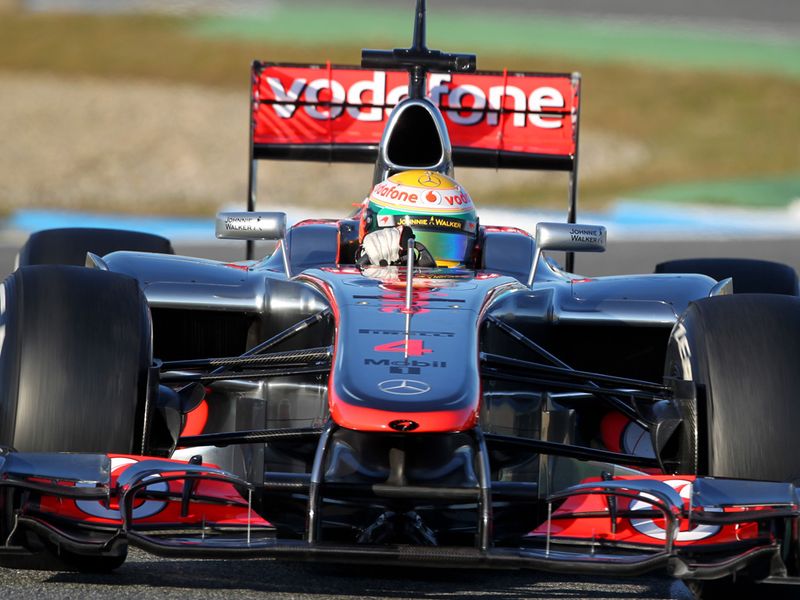 First on track for the first test of the 2012 season in
Jerez was the Caterham, the first car to be launched, with a new ‘platypus’
front wing. New regulations for this year means that the front end of the car
and specifically the front wing, has to be lowered, so that accidents like Mark
Webber’s in Valencia 2010 don’t happen frequently, where he went scarily
airborne. Quite frankly, the front wing looks utterly horrible – Martin Brundle
said, when referring to the over-zealous and over-complicated 2009 front wings
(following the biggest rule changes to hit the sport in years at that time)
that they’ll “need to be covered with brown bags” because they look so bad, and
I suspect he’ll be saying the same thing this year. Even Adrian Newey, the Red
Bull designer, has resorted to the stepped front wing. The only team which hasn’t
resorted to his horrific wing, which looks like it’s been designed with Lego
quite frankly, is McLaren. McLaren have decided to lower the whole of the front
end of the chassis and their front wing takes a more natural curved contour,
which in theory, should make air flow more consistent. But naturally, there
will be less grip than last year due to the fact that the area under the front
wing isn’t so high, so air is being channelled as much through the front of the
car. But a bigger cause for concern for several of the teams, has to be the
rear end.
First on track for the first test of the 2012 season in
Jerez was the Caterham, the first car to be launched, with a new ‘platypus’
front wing. New regulations for this year means that the front end of the car
and specifically the front wing, has to be lowered, so that accidents like Mark
Webber’s in Valencia 2010 don’t happen frequently, where he went scarily
airborne. Quite frankly, the front wing looks utterly horrible – Martin Brundle
said, when referring to the over-zealous and over-complicated 2009 front wings
(following the biggest rule changes to hit the sport in years at that time)
that they’ll “need to be covered with brown bags” because they look so bad, and
I suspect he’ll be saying the same thing this year. Even Adrian Newey, the Red
Bull designer, has resorted to the stepped front wing. The only team which hasn’t
resorted to his horrific wing, which looks like it’s been designed with Lego
quite frankly, is McLaren. McLaren have decided to lower the whole of the front
end of the chassis and their front wing takes a more natural curved contour,
which in theory, should make air flow more consistent. But naturally, there
will be less grip than last year due to the fact that the area under the front
wing isn’t so high, so air is being channelled as much through the front of the
car. But a bigger cause for concern for several of the teams, has to be the
rear end.
Being the sport that it is, with every million spent in
search of the next magic trick to find a winning half second, it’s no surprise that
F1 isn’t a stranger to banned aids. For example, there was the banning of ABS,
active suspension and traction control for 1994. There was the banning of
traction control once more for 2008. And the banning of those mass dampers that
Renault pioneered. This year, it’s the blown diffusers, which blow gases over
the diffuser to maximise grip. It was a system that Red Bull pioneered, and
since the ’10 European Grand Prix, most of the teams have tried to incorporate
this blown diffuser. So it’s perhaps no surprise that Red Bull is alleged to be
the team most affected by these rule changes as their whole car was built
around the blown diffuser mechanism. So without the blown diffusers for this
year, what will now be the pecking order for this year?
One may turn to last year’s British Grand Prix. The teams that
weekend had to resort to cold-blowing of the diffuser, as off-throttle blowing
was banned. Ferrari took the reigns that Alonso won their only race of the
season. Any coincidence? Not really – as Ferrari has several updates that
weekend, but Red Bull were still in the mix, despite Alonso’s dominant win; and
as for McLaren – they had a weekend to forget with Button’s retirement and
Hamilton starting to drift further from the pace, partly due to being in fuel
management, and the fact that they weren’t extremely fast in the dry either.
But we can’t say it is a definitive barometer of the performance for this year.
Or can we?
Ted Kravitz from Sky Sports F1 tweeted a few days ago,
reporting that Lewis Hamilton (see above left) said that McLaren were missing high speed
downforce and Red Bull and Lotus looked quick. Of course what we don’t know is
whether the loss of high speed downforce is relative, compared to the other
teams, or whether in general, he’s saying the regulations have meant in
reduction in rear-end grip. Frankly, the blown diffuser being banned is a
change for the better. The cars were too grippy, Vettel was often opening his
DRS mid-corner and the exhaust sounds sounded like a bag of rattling nails,
especially Lotus Renault’s forward-facing, experimental but failed exhaust. But
there’s no guarantee to say that the banning of the blown diffuser will mean a
more equal field. Evidence suggests that in times of rule changes, Adrian Newey
often triumphs (perhaps excluding the 1994 and 95 rule changes where they
[Williams Renault] failed to win the Drivers’ Championship). For example, in
1998 with the narrower car width and grooved tyres, McLaren were exceedingly
quick and despite the banning of their brake-steer system, were still reasonably
faster than the advancing Ferraris; 2005 with the lower-capacity V10 engines
and the more acute rear wing angles, and McLaren had a very quick car if
unreliable, and Kimi Raikkonen had several stunning victories in that car
including one at Monaco and one at one of the best races, in Suzuka,
Japan.
Adrian Newey is now at Red Bull. McLaren need to return to
winning ways, and so do Ferrari, who have designed a functional and radical car
to try and secure the title this year, and Mercedes, who must be feeling
pressure to deliver a car that supplements the talent of both Michael
Schumacher and Nico Rosberg. They topped
the timesheets in Jerez, but that has often proved to be a false guide, and it remains
to be seen if this is a mirage, with the Germans running last year’s car albeit
with new-spec tyres.
Other teams who need a revival this year are Lotus, who had
a satisfactory year this year and slid down the table after having a podium in
the first two races last year, courtesy of Petrov and Heidfeld, due to their
failed forward-facing exhaust. And in particular, Williams. The last time they
won a race was 2004 in the hands of Montoya, and since then, it has been a
steady and gradual decline for a team who last won a Constructors’ Championship
in 1997. They’ve got Maldonado and ironically, Senna, on onboard – here’s
hoping that he can prove his talent and quality and drive this team which has a
lot of potential onboard, after a period of creative renewal. For sure, the sun
has risen in Jerez for a new season. But it’s a long hard slog to go until the
sun sets for the 2012 season in Abu Dhabi.

No comments:
Post a Comment